
Personal Injury Lawyer
Common Injuries in Georgia Motorcycle Accidents and How Fault Is Determined
· By Vishay Singh
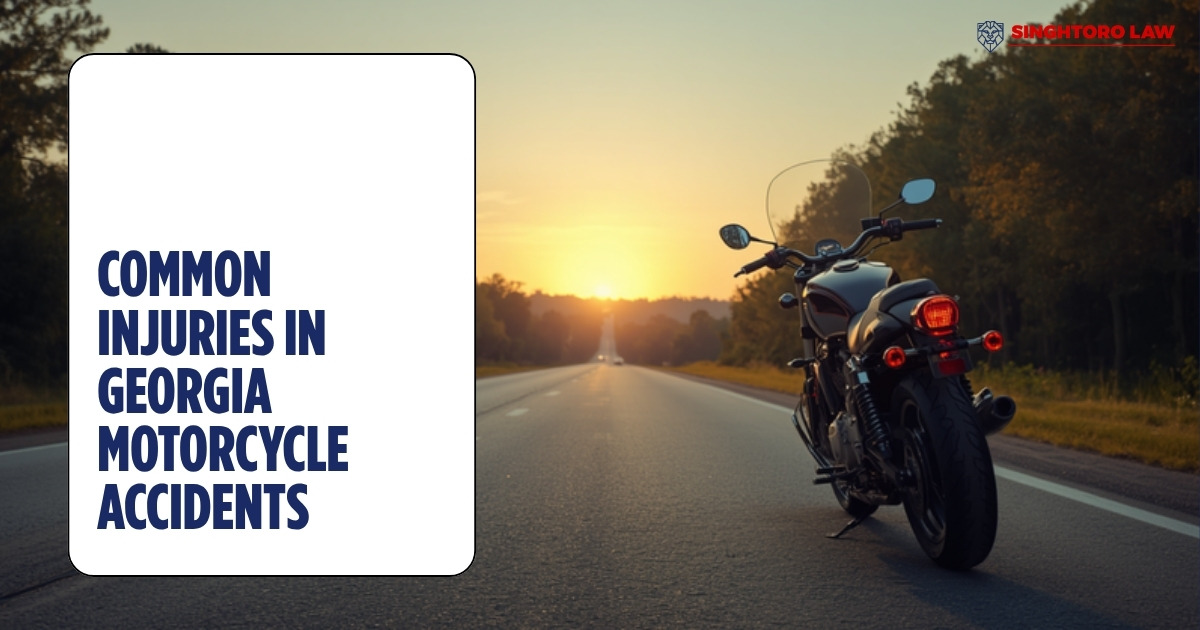
A motorcycle crash can cause injuries ranging from road rash to a traumatic brain injury, but how badly someone is hurt has no bearing, by itself, on who is legally at fault. Fault in a Georgia motorcycle accident is decided by evidence — traffic violations, physical evidence at the scene, witness accounts, and applicable Georgia law — not by the severity of anyone's injuries.
This article explains the injuries motorcyclists commonly sustain, how Georgia determines fault after a crash, how the state's comparative negligence law affects compensation, and two questions that come up often: whether not wearing a helmet can hurt a claim, and what happens when the other driver says they never saw the motorcycle.
Key Takeaways
- Motorcycle crashes commonly cause road rash, fractures, head and brain injuries, spinal injuries, and internal injuries.
- Fault is based on evidence about how the crash happened, not on how severe anyone's injuries turned out to be.
- Georgia uses a modified comparative negligence rule (O.C.G.A. § 51-12-33): compensation is reduced by your percentage of fault, and you cannot recover anything if you are found 50% or more at fault.
- Not wearing a helmet does not decide who caused the crash. Under Georgia law, however, it can be raised as an argument about the severity of certain injuries.
Common Injuries After a Motorcycle Accident
A motorcycle offers none of the structural protection a car provides, so even a relatively low-speed crash can cause injuries that would be minor in a car accident.
Road Rash and Soft-Tissue Injuries
Sliding across pavement after being thrown from a motorcycle causes road rash — abrasions that range from surface-level to deep enough to damage muscle, nerves, or require skin grafts. Riding gear reduces but doesn't eliminate this risk.
Broken Bones and Orthopedic Injuries
Collarbones, wrists, ankles, and legs are frequently broken in motorcycle crashes, often from bracing for impact or being pinned under the motorcycle. Some fractures require surgical repair with plates, screws, or rods.
Head and Traumatic Brain Injuries
Head injuries are among the most serious outcomes of a motorcycle crash. According to the Insurance Institute for Highway Safety, citing NHTSA research, helmets reduce the risk of death in a motorcycle crash by roughly 37% to 42%, and unhelmeted riders are about three times more likely to suffer a traumatic brain injury than helmeted riders. That doesn't mean a helmeted rider can't sustain a serious head injury — it means the risk is measurably higher without one.
Spinal and Back Injuries
The forces involved in a motorcycle crash can injure the vertebrae, discs, or spinal cord itself, sometimes resulting in chronic pain, nerve damage, or paralysis.
Internal Injuries
Blunt-force trauma from impact with a vehicle, the road, or roadside objects can injure internal organs. These injuries are not always obvious right away, which is one reason prompt medical evaluation matters — beyond the immediate health benefit, it also creates a medical record close in time to the crash, which can matter later if there's a dispute about what injuries the crash actually caused.
How Fault Is Determined in a Georgia Motorcycle Accident
Georgia doesn't have a single test for fault; it's built from the available evidence, including:
- Traffic-law violations — who had the right of way, ran a signal, made an unsafe lane change, or, for a motorcyclist, rode between lanes of traffic, which Georgia law prohibits (O.C.G.A. § 40-6-312)
- Physical evidence — skid marks, debris location, and the point of impact
- Police documentation — the officer's crash report and any citations issued
- Witness statements — accounts from people who saw the crash happen
- Photographs and video — from the scene, nearby businesses, or traffic cameras
- Vehicle damage — the location and pattern of damage can indicate how the vehicles collided
- Available electronic data — such as dashcam footage or, in some cases, a vehicle's onboard event data
- Accident reconstruction analysis — used in more complex or disputed cases to model how the crash occurred
No single piece of evidence usually decides fault on its own; insurers and courts weigh it together.
Georgia's Comparative Negligence Rule
Georgia follows a modified comparative negligence rule under O.C.G.A. § 51-12-33. Two things follow from that:
- If you're partly at fault, your compensation is reduced by your percentage of fault.
- If you're found 50% or more at fault, Georgia law bars you from recovering anything.
As an example: if a court finds your damages total $60,000 and determines you were 30% at fault for the crash, your recoverable compensation would be reduced to $42,000. If that same finding put you at 50% or more at fault, you would not be entitled to recover any damages. This is a general illustration of how the math works, not a prediction of any particular case's outcome — every crash is evaluated on its own facts.
Does Not Wearing a Helmet Affect a Georgia Motorcycle Claim?
Georgia law (O.C.G.A. § 40-6-315) requires every motorcycle operator and rider to wear a helmet that meets the standards set by the Commissioner of Public Safety — there is no age exemption for adult riders. Eye protection is also required unless the motorcycle has a windshield.
Whether not wearing a helmet affects a legal claim is a more nuanced question than a simple yes or no:
- It does not determine who caused the crash. Fault for causing a collision is based on the traffic violations and evidence described above — not on what the rider was wearing.
- It can become relevant to damages. In a disputed claim, a helmet-related argument may focus on whether the lack of a helmet contributed to the severity of a particular injury rather than on who caused the collision.
Not wearing a helmet does not automatically eliminate a claim, and it does not automatically reduce compensation — the outcome depends on the specific facts of the crash and how Georgia's comparative-fault law applies to them.
What If the Driver Says They Never Saw the Motorcycle?
"I never saw the motorcycle" is one of the most common statements drivers make after turning left in front of a rider or pulling out of a side street or driveway. It's also not, by itself, a defense — a driver's failure to see something they had a duty to look for can itself be evidence of negligence.
These cases usually come down to reconstructing what each person could have seen and when, using:
- The traffic signal or right-of-way rules in effect at the time
- Sight lines at the intersection or driveway, including any obstructions
- The motorcycle's speed and position leading up to the crash
- Witness accounts of what happened in the seconds before impact
- Any available video, whether from a dashcam, doorbell camera, or nearby business
A driver's account of what they saw or didn't see is one piece of the picture — it isn't the final word on fault.
Evidence That Can Matter in a Motorcycle Accident Claim
Beyond what's already been mentioned, evidence that tends to matter in a disputed motorcycle claim includes:
- The official police crash report
- Photographs of the vehicles, the scene, and visible injuries
- Contact information for anyone who witnessed the crash
- Medical records documenting treatment and the timeline of symptoms
- Repair estimates or damage assessments for the motorcycle
- Insurance correspondence, including any recorded statements
If it's safe to do so, documenting the scene and injuries close in time to the crash is useful — but personal safety and getting medical care come first.
What Compensation May Be Available?
Depending on the facts of the crash and the injuries involved, compensation in a Georgia motorcycle accident claim can include categories such as medical expenses, lost income, property damage to the motorcycle and gear, and pain and suffering. What's actually available in a given case depends on the injuries, the evidence of fault, and Georgia's comparative negligence rule described above. For a broader look at how a personal injury claim moves from an initial report through settlement or trial in Georgia, see our guide to filing a personal injury claim in Georgia.
When It May Make Sense to Speak With an Attorney
Not every motorcycle accident requires a lawyer. But a few situations tend to make the fault-and-damages analysis harder to work through alone: fault is disputed, the insurance company is arguing you were partly responsible, injuries are serious or expected to have lasting effects, or more than one vehicle or driver is involved. In those situations, Georgia motorcycle accident attorneys can review the evidence, evaluate how comparative negligence applies to your specific facts, and handle communication with insurance adjusters.
Frequently Asked Questions
What are the most common injuries in a motorcycle accident?
Road rash, broken bones, head and brain injuries, spinal injuries, and internal injuries are among the most common, largely because a motorcycle provides little physical protection compared to a car.
How is fault determined in a Georgia motorcycle accident?
Fault is based on the evidence — traffic-law violations, physical evidence, police reports, witness statements, and available video or vehicle data — not on injury severity or who was riding a motorcycle versus driving a car.
Can I recover compensation if I was partly at fault?
Often, yes. Georgia's modified comparative negligence law reduces your compensation by your percentage of fault, but only bars recovery entirely if you're found 50% or more at fault.
Can not wearing a helmet affect my motorcycle accident claim?
It doesn't determine who caused the crash, but in a disputed claim it may be argued that it contributed to the severity of a particular injury, which could affect the compensation available for that injury depending on the facts.
What if the other driver says they didn't see me?
That statement isn't a defense by itself. Fault still depends on evidence like right-of-way rules, sight lines, and witness or video evidence — not just the driver's account.
What evidence can help establish fault?
Police reports, photos and video, witness statements, medical records, and vehicle damage patterns are the evidence most often used to determine how a motorcycle crash happened and who was responsible.
Related Articles

Free Case Evaluation
Tell us what happened. We will tell you where you stand.
Every consultation is confidential and free of charge. There is no fee unless we recover for you.