

Personal Injury Lawyer
Can Not Wearing a Seat Belt Affect Your Georgia Car Accident Claim? What Changed Under the 2025 Law
· By Vishay Singh
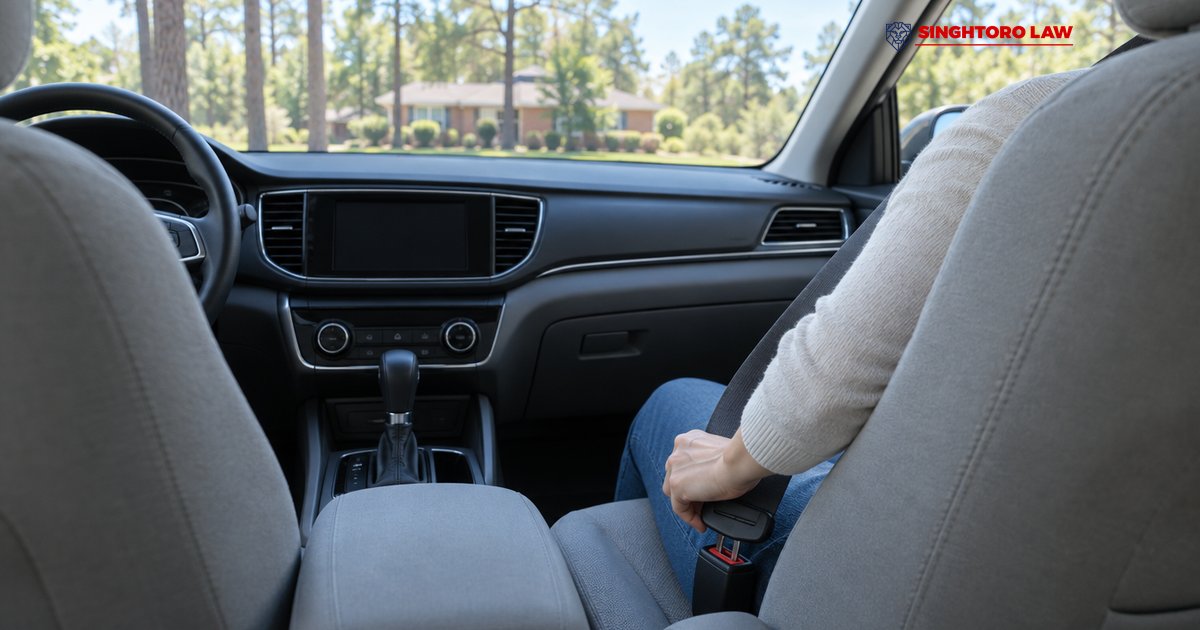
Yes, it can, but not automatically, and not in the way many people assume. Since April 21, 2025, Georgia law allows evidence that an injured person was not wearing a seat belt to be considered in car accident lawsuits that the new rule covers. Before that change, Georgia law generally kept that fact away from juries. Not wearing a seat belt still does not mean you caused the crash, and it does not cut your compensation by any set amount. What it can do is open an argument about whether a seat belt would have prevented or reduced some of your injuries.
The change also does not apply to every case. The two 2025 bills that made the change contain different timing provisions. The one that an editor's note in the Georgia Code treats as governing says the new rule applies only to cases "commenced" on or after April 21, 2025, and not to cases already pending on that date. This guide explains what Georgia's seat belt law requires, what changed, what the change does not do, and how the issue tends to come up in an insurance claim and in court.
Legal Update — October 2026
Georgia changed its rules concerning seat-belt evidence in personal injury cases in April 2025. However, SB 68 and SB 69 contain different provisions addressing when the changes apply.
As of this article's last review in October 2026, our research has not identified a published Georgia appellate decision definitively resolving how those provisions interact.
The application of the amended rule may depend on the circumstances and procedural history of a particular case. Readers should not assume that the date of an accident or lawsuit filing alone determines which rule applies.
This article explains the available law and identifies areas where interpretation remains unsettled.
The Short Answer
- You can still bring a claim. Nothing in Georgia law bars an injury claim because the injured person was unbelted.
- It is not evidence of who caused the crash. A seat belt protects the person wearing it. It has nothing to do with whether a driver ran a light, followed too closely, or was distracted.
- It may now be raised about your injuries. In cases the new rule covers, the other side may argue that a seat belt would have prevented or lessened certain injuries, and a jury may consider that in assigning fault and deciding damages.
- A judge still decides what the jury hears. The statute keeps the court's power to exclude the evidence under Georgia's rules of evidence.
- Timing matters, and it is not settled. The timing provision that the Code's editor's note treats as governing says the new rule applies to cases commenced on or after April 21, 2025, and not to cases pending on that date. How the two 2025 bills' timing provisions fit together, and how they apply to a crash that happened before that date, has not been settled.
What Georgia's Seat Belt Law Requires
Georgia's seat belt statute, O.C.G.A. § 40-8-76.1, sets different rules depending on where you sit and how old you are:
- Front seat: every occupant of the front seat of a passenger vehicle, driver and passengers of any age, must wear a seat belt on public roads.
- Minors 8 and older: must be buckled in any seat. If one is not, the driver can be cited for failing to secure a seat belt on a minor.
- Children under 8: a separate statute, O.C.G.A. § 40-8-76, requires a child restraint suited to the child's height and weight, generally in a rear seat.
- Adults in the back seat: Georgia's statute does not currently require adults 18 and older in the rear seat to buckle up.
"Passenger vehicle" includes cars, pickup trucks, vans, and SUVs designed for 15 or fewer passengers. It does not include motorcycles. The statute lists exceptions, including a person with a physician's written statement that they cannot wear a belt for medical reasons, a driver backing up, vehicles with a model year before 1965, rural mail carriers on duty, and vehicles performing an emergency service.
For an adult, the ticket is small: a fine of no more than $15. That traffic penalty is a separate matter from what the same fact can mean in an injury case.
What Georgia Law Said Before 2025
For decades, Georgia law kept seat belt evidence out of car accident cases. The former version of § 40-8-76.1(d) said that an occupant's failure to wear a seat belt could not be considered evidence of negligence or causation, could not be considered on any question of liability, and could not be used to reduce any recovery for damages in a motor vehicle case.
In practice, that meant a jury generally never heard whether the injured person was buckled. The defense could not argue that a belt would have prevented an injury, and a judge could not instruct the jury that it could take seat belt use into account.
What Changed Under the 2025 Law
In 2025, the General Assembly rewrote § 40-8-76.1(d) as part of a broader package of changes to Georgia's civil justice laws. The identical amendment appears in two bills, Senate Bill 68 and Senate Bill 69, both signed by Governor Kemp on April 21, 2025, and the seat belt change took effect that day.
What the New Rule Says
The statute now provides that an occupant's failure to wear a seat belt, in any seat of a vehicle equipped with one, "may be considered in any civil action as evidence admissible on the issues of negligence, comparative negligence, causation, assumption of risk, or apportionment of fault or for any other purpose," and may be evidence used to diminish a recovery for damages.
Three details in that language matter:
- It says "may," not "shall." The evidence is allowed, not required, and the law does not set any automatic reduction.
- It refers to "any seat." Being required to wear a seat belt and having non-use raised as evidence are two different questions. The duty to buckle depends on age and seat; for adults, it covers only the front seat. The evidence rule is worded more broadly: it refers to an occupant's failure to wear a belt in "any seat" of a vehicle that has belts. So an adult riding unbelted in the back seat generally breaks no traffic law, but the wording of the evidence rule does not exclude that passenger. Whether and how courts will admit the evidence in that situation has not been settled.
- The judge keeps the final say on admissibility. The statute states that it does not prevent a court from deciding whether the evidence is admissible under O.C.G.A. § 24-4-403, which allows a judge to exclude relevant evidence when its value is substantially outweighed by the danger of unfair prejudice, confusion, or misleading the jury, or under any other rule of evidence.
Which Cases the New Rule Covers
Published summaries of the 2025 law do not agree on this point, and the reason is in the two bills themselves. Senate Bill 68 said that most of its provisions would apply to cases already pending. Senate Bill 69, which made the same seat belt change, said the opposite for that change: it "shall not apply to causes of action pending on the effective date," it applies "only to causes of action commenced on or after" April 21, 2025, and earlier ones are governed by the old law. An editor's note published with the Georgia Code states that SB 69 was signed last and that its applicability language therefore governs. That note is an editorial annotation, not a court ruling, and some legal commentary has instead read SB 68's broader language as reaching the seat belt change in pending cases.
If SB 69's wording controls, two points follow. First, cases that were already pending on April 21, 2025 stay under the old rule. Second, for cases started later, the word "commenced" matters. Under Georgia's Civil Practice Act, a civil action is commenced by filing a complaint with the court, which points to the date the lawsuit was filed. But the provision speaks of "causes of action" commenced, and some legal commentary has tied the new rule to when the crash happened instead. As of this writing, we have not identified a published Georgia appellate decision resolving either question. If your crash happened before April 21, 2025, have a lawyer look at how the rule applies to your case.
What the New Rule Does Not Do
- It does not make an unbelted person responsible for causing a crash.
- It does not set a percentage or formula for reducing compensation.
- It does not guarantee that a jury will hear the evidence in every case.
- It does not change who must wear a seat belt or the fines for not wearing one.
- It does not allow your insurer to cancel your policy or raise your rates because you were not wearing a belt. The same statute still prohibits that.
- It did not amend the separate child-restraint statute, which still says that a violation of that law is not negligence per se or contributory negligence per se.
Does Not Wearing a Seat Belt Mean You Caused the Crash?
No. Fault for a collision depends on how the crash happened: who failed to yield, who was speeding, who was looking at a phone. A seat belt does nothing to prevent a collision. It only affects what happens to the person inside the vehicle once a collision occurs.
The same is true of a seat belt ticket. A citation for not wearing a belt says nothing about whether you were driving safely, and a passenger who was unbelted was not driving at all. The other driver's negligence is still proved with the usual evidence: the crash report, photographs, witness statements, video, and vehicle damage.
How Seat Belt Evidence May Affect Injury Damages
Where the new rule applies, the real dispute is usually about causation of specific injuries, not of the crash. The question becomes: would a seat belt have prevented this injury, or made it less severe?
The answer depends on the injury and the collision, and it is often a matter for medical and engineering evidence rather than common sense. Some injuries may occur whether or not a person is belted. Others, such as injuries from striking the windshield or being thrown from the vehicle, may be more directly tied to belt use. An argument about seat belts that is not connected to the actual injuries in the case is weaker than one that is, and it may be challenged before trial.
Under Georgia's general evidence rule, the burden of proof generally lies on the party asserting a fact. In practice, a defendant who argues that not wearing a belt caused or worsened an injury will generally need evidence to support that argument. The 2025 amendment itself does not say who must prove what about seat belt use.
Because the law is new, there is no settled body of Georgia appellate decisions yet explaining exactly how judges should handle this evidence, what kind of proof is needed to connect non-use to a particular injury, or how juries should be instructed.
How Comparative Fault Fits In
Georgia uses a modified comparative fault rule, found in O.C.G.A. § 51-12-33. If an injured person is found partly responsible for the injury or damages claimed, the award is reduced by that person's percentage of fault. If the injured person is found 50 percent or more responsible, they recover nothing. The statute speaks of responsibility for "the injury or damages claimed," not only for the crash itself.
The 2025 amendment specifically lists "comparative negligence" and "apportionment of fault" among the issues on which seat belt evidence may be considered. That means that in a case under the new rule, a jury may be asked to consider seat belt non-use when it assigns percentages of fault. It is important to keep two questions apart:
- Who caused the crash? Seat belt use does not answer this.
- Who is responsible for the extent of the injuries? This is where the defense may try to use seat belt evidence.
The statute does not tell a jury how much weight to give the evidence, and it does not set any minimum or maximum share of fault. Not wearing a belt does not automatically establish any percentage of fault, and we have not identified a Georgia appellate decision addressing how much weight seat belt evidence can carry under the new rule. Any effect depends on the evidence in that particular case. Our guide to personal injury claims in Georgia explains how comparative fault works more generally.
Motorcyclists face a similar argument about helmets. Our article on motorcycle accident injuries and fault in Georgia explains why protective gear goes to the severity of injuries, not to who caused the collision.
Insurance Claims vs. What a Jury Hears
Most car accident claims are resolved with an insurance company, not in front of a jury. The rules of evidence decide what a jury may hear at trial. They do not limit what an adjuster can raise while negotiating.
Before 2025, an adjuster might mention that you were not belted, but the argument had limited force because the evidence generally could not be used at trial. For cases covered by the new rule, an insurer evaluating a claim knows the issue could reach a jury and may factor that into its position. That does not mean the argument is correct for your injuries, and it does not mean any particular discount is justified. Whether seat belt use actually made a difference is still a question of evidence.
Because Georgia is an at-fault state, these arguments come up in negotiations with the at-fault driver's liability insurer. Our explainer, Is Georgia a No-Fault State?, walks through how those claims and the coverage on your own policy work.
Hypothetical Examples
The following are hypothetical examples, for illustration only. They are not based on any client's case and do not predict the outcome of any claim.
A Back-Seat Passenger in a Red-Light Crash
An adult passenger is riding unbelted in the back seat of a friend's car when another driver runs a red light and strikes the car broadside. The passenger suffers a broken arm and a head injury. Georgia did not require the adult rear-seat passenger to wear a belt, but the evidence rule's wording refers to "any seat," so the defense may try to raise it. The other driver's red-light violation still decides who caused the crash. The dispute would center on whether a belt would have changed either injury, and the answer may differ for the arm and the head injury.
An Unbelted Driver in a Rear-End Collision
A driver who had unbuckled while stopped in traffic is rear-ended by a distracted driver and later diagnosed with a neck injury. The defense argues that the driver's recovery should be reduced. Whether a seat belt would have made any difference to that injury in that kind of collision is a medical and engineering question. If the defense cannot connect non-use to the injury, the evidence may be challenged before trial, and even if it is admitted, the jury decides how much weight it deserves.
When the Lawsuit Was Filed
Two people were injured in separate crashes in early 2025 and were not wearing seat belts. One filed suit in February 2025. The other negotiated with the insurer for months and filed in the summer of 2025. The first case was already pending on April 21, 2025. SB 69 says the new rule does not apply to pending cases, so under SB 69's wording that case stays under the old rule, which keeps seat belt evidence out. Commentary that reads SB 68's broader language as controlling would reach a different result. The second case is less certain. If the filing date controls, the new rule would apply. If the date of the crash controls, it would not. Until the courts settle the question, a lawyer should look at how the rule applies to a specific case.
Evidence That May Matter in a Seat Belt Dispute
- The crash report, which may record restraint use for each occupant.
- Medical records, including emergency room and EMS records, which may note restraint use and describe how injuries occurred. Bruising from a belt across the chest or abdomen is sometimes documented.
- The vehicle itself, including the belts, buckles, airbags, and the interior where an occupant may have struck the cabin.
- The vehicle's event data recorder, which in many vehicles can record information about the crash and, in some cases, whether the driver's belt was buckled.
- Photographs and witness accounts from the scene.
- Expert analysis, such as a physician's opinion about how an injury occurred or an accident reconstruction or biomechanical analysis, when the effect of a belt is disputed.
Some of this evidence can be lost quickly. A vehicle may be repaired, sold, or salvaged, and recorded data may not be preserved unless someone acts to keep it.
What to Do If You Were Hurt and Not Wearing a Seat Belt
- Get medical care and follow your treatment plan. Your records will be central to any question about how your injuries happened.
- Be truthful. If you are asked whether you were wearing a belt, do not guess and do not shade the answer. An inconsistent account can create problems of its own.
- Be careful with recorded statements to the other driver's insurer. You generally have no obligation to give one, and it is reasonable to get advice first.
- Preserve evidence. Take photographs of the vehicle interior, belts, and airbags, and avoid having the vehicle repaired or disposed of before the evidence has been documented.
- Write down the dates, including the date of the crash and, if a lawsuit is filed, the filing date, because these dates may matter for which seat belt rule applies.
- Keep the deadline in mind. In Georgia, the general deadline to file a lawsuit for personal injuries is two years from the crash, with limited exceptions.
If the other driver fled the scene, the same seat belt questions can come up in a claim under your own uninsured motorist coverage. See our guide to hit-and-run accidents in Georgia.
Frequently Asked Questions
Can I still recover compensation if I wasn't wearing a seat belt in Georgia?
Yes. Not wearing a seat belt does not bar a claim. In a case covered by the 2025 rule, it may be raised as an argument about the extent of your injuries, and a jury may consider it in assigning fault. Recovery is barred only if you are found 50 percent or more responsible. Not wearing a belt does not automatically put you at any particular percentage, and how any share of fault is assigned depends on the evidence.
Do adults have to wear a seat belt in the back seat in Georgia?
Not under the current statute. The adult requirement applies to the front seat. Minors 8 and older must be belted in any seat, and children under 8 must be in an appropriate child restraint. Being required to buckle and having non-use raised in an injury case are separate questions, though. The 2025 evidence rule refers to a failure to wear a belt in "any seat," and courts have not yet settled how it applies to adults in the back seat.
Can my insurance company cancel my policy or raise my rates because I wasn't buckled?
No. Georgia's seat belt statute still says that not wearing a seat belt cannot be a basis for cancelling insurance coverage or increasing insurance rates.
Does the new rule apply to my crash from before April 2025?
Possibly. It depends on how courts read the 2025 timing provisions, and it may also depend on the circumstances and procedural history of your case. SB 69's provision, which the Code's editor's note treats as governing, says the new rule does not apply to cases pending on April 21, 2025, and applies to causes of action "commenced" on or after that date. A civil action is commenced by filing a complaint, which points to the filing date, but some commentary ties the rule to the crash date, and we have not identified a published Georgia appellate decision settling the question. If your crash happened before April 21, 2025, talk with a lawyer about how the rule applies.
What about children in car seats?
Children under 8 are covered by a separate statute, O.C.G.A. § 40-8-76, which requires the driver to secure the child in an appropriate child restraint, with limited exceptions. The 2025 change did not amend that statute. It still says a violation "shall not constitute negligence per se nor contributory negligence per se," which means a violation does not automatically establish negligence. How the 2025 seat belt evidence rule applies when an injured child was not properly restrained has not been settled, so these cases are worth discussing with a lawyer on their specific facts.
Talking to a Lawyer About a Seat Belt Issue
Seat belt evidence is new territory in Georgia, and whether it matters in a given case depends on the injuries, the collision, the evidence, and the dates of the crash and of any lawsuit. If you were hurt in a Georgia crash and the insurer is raising seat belt use, SinghToro Law's car accident attorneys can review what happened and how the current rules apply. To talk it through, request a free case evaluation.
This article provides general information about Georgia law and is not legal advice. Reading it does not create an attorney-client relationship. The 2025 seat belt evidence rule is new and courts have not yet settled how it applies in many situations. How the law applies depends on the specific facts of each case.
Related Articles

Free Case Evaluation
Tell us what happened. We will tell you where you stand.
Every consultation is confidential and free of charge. There is no fee unless we recover for you.