
Personal Injury Lawyer
Georgia Truck Accident Liability: Who Can Be Held Responsible and Why
· By Vishay Singh
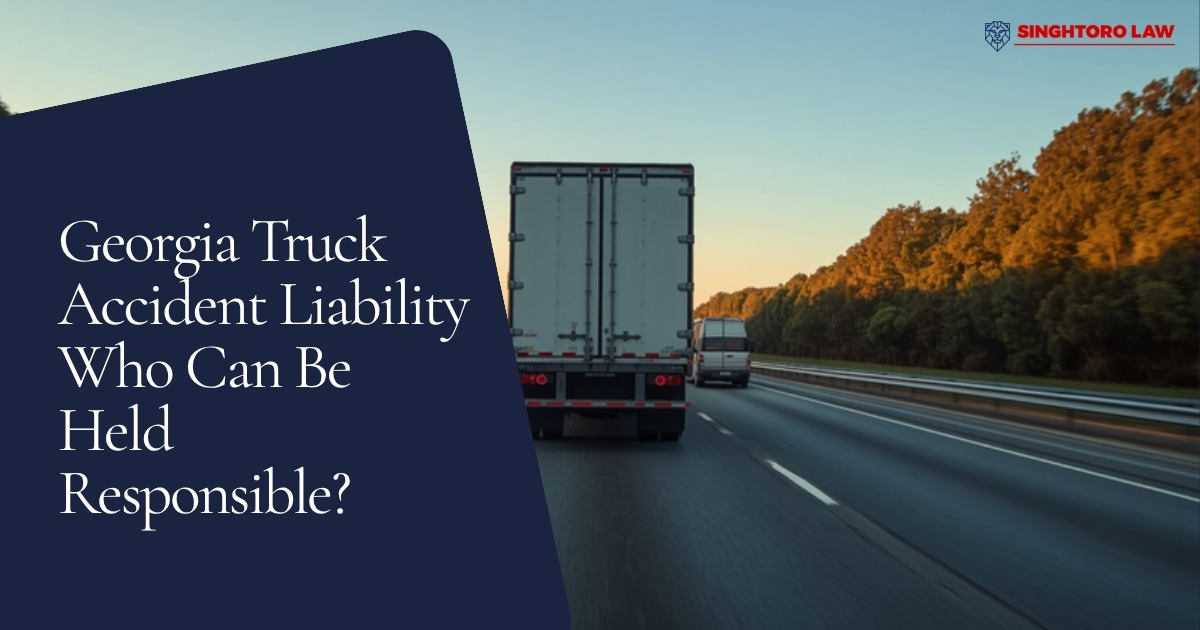
When a commercial truck crash causes serious harm, one of the first questions is simple to ask and often complicated to answer: who is actually responsible? Unlike a typical two-car accident, a truck crash can involve several separate companies and legal relationships behind the driver, and Georgia law allows more than one of them to share fault at the same time.
This article explains how liability works in a Georgia truck accident — who can potentially be held responsible, what evidence is typically used to investigate fault, how federal trucking regulations can factor into a liability case, and how Georgia's comparative negligence rule applies when more than one party is at fault. It focuses on the legal mechanics of liability rather than the injuries a crash can cause, since those mechanics are often what determines whether — and from whom — compensation is actually available.
Key Takeaways
- More than one party can share legal responsibility for a Georgia truck accident — the driver, the motor carrier, and potentially other companies involved in loading or maintaining the truck.
- Georgia law lets a jury weigh a trucking company's own hiring, training, supervision, retention, and entrustment decisions separately from its vicarious responsibility for the driver (Quynn v. Hulsey, 2020).
- Federal trucking regulations — covering hours of service, driver qualification, vehicle maintenance, and cargo securement — can become relevant evidence of negligence when they've been violated.
- Georgia's modified comparative negligence rule (O.C.G.A. § 51-12-33) applies to truck accidents the same way it applies to other injury claims: compensation is reduced by your percentage of fault, and barred entirely if you're 50% or more at fault.
- Some trucking records, like records of duty status and supporting documents, are only required to be kept for a limited time, which is one reason prompt evidence preservation can matter.
Why Truck Accident Liability Can Be More Complicated Than a Typical Car Crash
In a routine two-car accident, liability usually comes down to which driver broke a traffic law or otherwise failed to drive safely. A commercial truck accident can involve that same question, plus several more, because a truck crash sits inside a web of business relationships a private car accident doesn't have.
The driver may be a company employee, or may be leased to the carrier through a separate business arrangement. The truck and trailer may be owned by different companies. The cargo may have been loaded by a business that has nothing to do with the trucking company itself. Maintenance may be handled in-house or contracted out to a separate repair shop. Each of these relationships can matter to who is legally responsible when something goes wrong — and Georgia law allows more than one of them to be responsible at the same time, in different proportions.
Who May Be Responsible for a Georgia Truck Accident?
Determining who may be responsible starts with looking at everyone actually involved in the events leading to the crash — not just the driver behind the wheel.
The Truck Driver
The driver can be held responsible for their own negligent conduct — speeding, following too closely, driving while fatigued, or violating a traffic law, for example. Some crashes involve a hazard specific to large trucks, such as a driver moving into a lane without checking a known blind spot; we cover that specific issue in more detail in our guide to truck blind-spot dangers. This is the most straightforward potential source of liability, and it exists independently of who the driver worked for.
The Motor Carrier or Trucking Company
A trucking company can be held responsible in more than one way. It may be vicariously responsible for its driver's negligence under the legal doctrine of respondeat superior, which generally holds an employer responsible for an employee's negligent acts committed within the scope of employment. Whether — and how — that responsibility applies can depend on the specific relationship between the driver and the carrier, since an owner-operator or a driver supplied through a leasing arrangement isn't always treated as an ordinary employee. Separately, the company can also be held responsible for its own conduct — such as how it hired, trained, supervised, or retained the driver, or how it maintained its vehicles. Georgia law treats these as two distinct potential sources of liability, not one — a distinction explained further below.
A Cargo-Loading Company
When a truck is loaded by a separate business — a shipper, warehouse, or logistics company — that business can potentially share responsibility if improperly loaded or secured cargo contributed to the crash, such as cargo that shifted or fell because it wasn't secured to federal requirements.
A Maintenance or Repair Provider
If a truck's brakes, tires, lights, or other systems failed because of improper maintenance or repair, the company or shop responsible for that maintenance may be a potentially responsible party, separate from the driver or the motor carrier.
A Vehicle or Parts Manufacturer
In cases where a genuine equipment or parts defect contributed to the crash — not simply wear, damage, or lack of maintenance — the manufacturer of the vehicle or the defective part may be a potentially responsible party under Georgia product liability principles. This applies only when a defect is actually involved, which is not the case in most truck accidents.
Other Potentially Responsible Parties
Depending on the facts, other parties may also be relevant, such as a company that leases trucks or drivers to a carrier, or another driver whose own negligence contributed to the crash.
None of these parties is automatically responsible simply because they had some connection to the truck. Establishing responsibility requires evidence connecting a specific party's conduct to the crash.
How Fault Is Investigated After a Commercial Truck Crash
Because more than one party can potentially be involved, investigating a truck accident usually means connecting specific evidence to a specific theory of fault, rather than simply gathering everything available. Evidence commonly relevant may include:
- The police crash report, which documents the officer's on-scene observations and any citations issued
- Photographs and video from the scene, dashcams, or nearby businesses
- Witness statements from other drivers or bystanders
- The truck's electronic logging device (ELD) data and driver logs, which can show whether the driver was operating within federal hours-of-service limits
- Vehicle inspection and maintenance records, which can show whether a mechanical problem was known or should have been caught
- Cargo-related records, when improperly loaded or secured cargo may have contributed to the crash
- Other electronic or vehicle data, when available
- The motor carrier's own company records, when legally obtainable, such as driver qualification files
Not every case involves every type of evidence, and what's actually available depends on the circumstances of the specific crash. What connects this evidence together is that each type tends to support a different potential theory of fault — ELD data supports an hours-of-service theory against the driver and carrier, maintenance records support a negligent-maintenance theory, and so on.
How Federal Trucking Regulations Can Affect Liability
Commercial trucking is regulated by the Federal Motor Carrier Safety Administration (FMCSA), and violations of these federal rules can become evidence of negligence in a Georgia truck accident case. A few of the regulations most often relevant include:
- Hours of service (49 C.F.R. § 395.3): generally limits a driver to 11 hours of driving after 10 consecutive hours off duty, and prohibits driving after the 14th hour following the start of a shift. A driver who violated these limits before a crash may support a fatigue-related negligence claim.
- Driver qualification (49 C.F.R. § 391.51): requires motor carriers to maintain a qualification file for each driver, including their employment application and driving record. Gaps in this file can be relevant to a negligent-hiring claim.
- Vehicle inspection and maintenance (49 C.F.R. Part 396): requires carriers to systematically inspect, repair, and maintain their vehicles, including a driver's post-trip inspection report and a required annual inspection.
- Cargo securement (49 C.F.R. Part 393, Subpart I): sets requirements for how cargo must be secured to prevent it from shifting or falling during transport.
A federal regulation violation doesn't automatically decide a case, but it can be significant evidence that a party fell below the standard of care expected of a commercial carrier.
How Georgia's Comparative Negligence Rule Applies
Georgia follows a modified comparative negligence rule under O.C.G.A. § 51-12-33. If you're found partly at fault for the crash, your compensation is reduced by your percentage of fault; if you're found 50% or more at fault, you're barred from recovering anything. This rule applies to a truck accident claim the same way it applies to any other Georgia personal injury claim. For a fuller explanation of how the claims process works generally, see our guide to filing a personal injury claim in Georgia.
What If More Than One Party Shares Responsibility?
Truck accident cases often involve more than one potentially responsible party at once — for example, a driver who was speeding and a carrier that failed to properly train them. Georgia law has specifically addressed how this works for trucking companies.
For years, Georgia courts followed a rule that let a trucking company avoid claims for its own negligent hiring, training, supervision, retention, or entrustment of a driver simply by admitting it would be vicariously responsible for that driver's negligence — as long as the case didn't also involve a valid punitive-damages claim. In 2020, the Georgia Supreme Court changed that. In Quynn v. Hulsey, the Court held that Georgia's apportionment statute (O.C.G.A. § 51-12-33) abrogated that older rule, meaning a jury can now consider a trucking company's own independent negligence — in how it hired, trained, supervised, retained, or entrusted a vehicle to its driver — separately from, and in addition to, its vicarious responsibility for the driver's conduct.
In practice, this means a truck accident claim isn't limited to proving the driver was negligent and stopping there. Depending on the evidence, a case may also examine the trucking company's own decisions leading up to the crash.
Why Preserving Truck-Accident Evidence Can Matter
Some of the records that matter most in a truck accident case aren't kept indefinitely. Federal regulations require motor carriers to retain each driver's records of duty status and supporting documents for only six months from the date received (49 C.F.R. § 395.8(k)). Once that window passes, those specific records may no longer be available — other categories of evidence, like maintenance or cargo records, are governed by their own separate retention rules. This is one reason evidence connected to a truck accident is often addressed promptly rather than left until later in the process.
When It May Make Sense to Speak With a Truck Accident Attorney
Not every truck accident requires a lawyer, but a few circumstances tend to make identifying and proving responsibility harder to work through alone: more than one company may be involved, the trucking company disputes its own responsibility, federal regulations may have been violated, or the available evidence is time-sensitive. In those situations, Georgia truck accident attorneys can help identify the potentially responsible parties, gather and preserve the relevant evidence, and evaluate how Georgia's comparative-negligence rule applies to the specific facts.
Frequently Asked Questions
Who can be held liable for a truck accident in Georgia?
Depending on the facts, potentially responsible parties can include the truck driver, the motor carrier or trucking company, a cargo-loading company, a maintenance or repair provider, and in rare cases a vehicle or parts manufacturer. More than one party can share responsibility at the same time.
Is the trucking company responsible for its driver's crash?
A trucking company can be vicariously responsible for a driver's negligence under respondeat superior, and separately responsible for its own hiring, training, supervision, retention, or entrustment decisions — two distinct potential sources of liability under Georgia law.
Can more than one company be responsible?
Yes. Georgia law allows fault to be apportioned among multiple responsible parties, including a driver and one or more companies, based on each party's share of fault.
What evidence can help prove fault in a truck accident?
Evidence may include the police crash report, photographs and video, witness statements, ELD and driver-log data, maintenance records, cargo records, and other company records, depending on what's available and relevant to the specific facts.
Do federal trucking regulations apply to every truck accident?
Federal regulations generally apply to commercial motor carriers and drivers, but which specific regulations are relevant depends on the facts of a given crash — not every regulation applies to every situation.
What happens if I was partly at fault?
Under Georgia's comparative negligence rule, your compensation is reduced by your percentage of fault, and you can't recover anything if you're found 50% or more at fault.
Related Articles

Free Case Evaluation
Tell us what happened. We will tell you where you stand.
Every consultation is confidential and free of charge. There is no fee unless we recover for you.